As you may know there are different acne types. It is good to be aware of this.
The term “Acne Vulgaris” is the term used to describe this group of skin conditions.
Non-inflammatory & inflammatory
Acne is then sub divided into two main types; non-inflammatory and inflammatory.
This condition can also afflict your skin with varying degrees of intensity.
Non-inflammatory acne will mostly manifest as whiteheads and blackheads. Whereas inflammatory acne may swell and be caused by an infection
Non-inflammatory acne is characterized by breakouts of white-heads and blackheads on your skin and normally dosen’t cause any swelling.
Non-inflammatory acne can usually be treated with over-the –counter treatments, by sticking to a good diet and by staying hydrated.
Blackheads happen when a pore is clogged by such things as a combination of oils , dead skin cells and sebum.
Whiteheads happen when a pore becomes clogged, but the top of the pore is closed (unlike blackheads, where the top of the pore remains open). Whiteheads are sometimes more difficult to treat than blackheads because the pore is not open. People often use products containing salicylic acid to treat non-inflammatory acne.
Inflammatory Acne Inflammatory acne is often much more aggressive than non-inflammatory acne. The pimples on your skin are often much bigger, they are swollen and red.
They often sometime cause pain to the person suffering the condition, as well as they fact that the person suffering from it will regard them as unsightly.
With inflammatory acne bacteria plays a role which will cause infection and make the acne outbreak more aggressive.
For inflammarory acne many doctors prescribe products containing benzoyl-peroxide.
Papules are red raised bumps that may be tender to the touch.
Pustules are similar to papules, but with a visible white or yellow centre filled with pus.
Cystic Acne
Cystic acne is a severe form of acne characterized by deep, painful cysts or nodules beneath the skin’s surface. These lesions are typically filled with pus and can cause significant discomfort and inflammation. Cystic acne often leads to scarring if left untreated.
Characteristics of cystic acne include large painful bumps. Cysts are larger than typical pimples and are often painful to the touch. They may develop deep within the skin, making them challenging to treat with topical medications alone.
There may also be significant inflammation. leading to redness and swelling in the affected area.
Cysts are typically filled with pus, a mixture of dead skin cells, bacteria, and oil. This gives them a white or yellowish appearance.
Cytic acne also has a tendency to scar due to the depth of the lesions and the inflammation involved.
Treating cystic acne often requires a comprehensive approach that may include prescription medications such as oral antibiotics, isotretinoin (Accutane), or hormonal therapies. In some cases, corticosteroid injections may be administered directly into the cyst to reduce inflammation and promote healing. It’s essential for individuals with cystic acne to consult a dermatologist for personalized treatment recommendations.
Severity of Acne
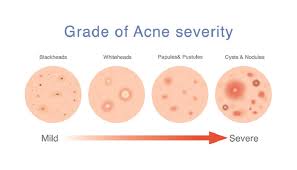
Acne severity can vary widely from person to person and depends on several factors, including the type of lesions present, their distribution on the skin, and the extent of inflammation. Dermatologists commonly use grading systems to assess acne severity. One widely used scale is the Global Acne Grading System (GAGS), which categorizes acne into four grades:
Grade 1 (Mild)
This grade typically involves the presence of comedones (whiteheads and blackheads) with few inflammatory lesions (papules and pustules). The acne is generally localized to specific areas of the face, such as the forehead, nose, and chin.
Grade 2 (Moderate)
Acne in this grade includes a higher number of comedones and inflammatory lesions. The lesions may be more widespread across the face, and there may be occasional nodules or cysts.
Grade 3 (Moderately Severe)
Acne in this grade is characterized by numerous comedones, papules, pustules, and occasional nodules or cysts. The lesions are more widespread and may also be present on the neck, chest, and back.
Grade 4 (Severe)
This grade represents severe acne with numerous comedones, papules, pustules, nodules, and cysts. The lesions are widespread and often cover large areas of the face, neck, chest, and back. Scarring is common in this grade.
In addition to the GAGS scale, dermatologists may also consider other factors such as the presence of scarring, the patient’s medical history, and any underlying hormonal imbalances when assessing acne severity. Treatment approaches will vary depending on the severity of the acne, with mild cases often responding well to topical treatments, while severe cases may require oral medications or other interventions. It’s important for individuals with acne to consult a dermatologist for an accurate assessment and personalized treatment plan.
Special Types of Acne
There are a number of special types of acne which are less common, sometimes mis-understood and behave somewhat differently from the regular acne- vulgaris.
Hormonal Acne is triggered by fluctuations in hormone (Androgens). This type of acne is common in adults, especially women.
This type of acne generally appears on the jawline, chin and neck. It is often deep and painful and tend to flare cyclically, like before menstruation.
Fungal Acne is actually caused by yeast, not by bacteria. It appears as small, uniform bumps and is often itchy.
Breakout are most common on the chest, back, shoulders and the forehead. It might worsen with antibiotics and generally responds to anti-fungal treatments not the regular kind of acne treatments.
Acne Mechanica is a kind of acne that results from constant skin irritation, from friction, pressure, heat ad trapped sweat. This can be the result of tight restrictive clothing, sports gear or masks which lead to clogged, inflamed pores and to breakouts like pimples.
This can be common in athletes, but it also can result from every-day items like backpack straps and even prolonged phone use.
To treat it you can try to reduce the irritation causing it by wearing loose fitting clothes with breathable fabrics. You can use gentle cleansers with your skincare routine and perhaps consult a dermatologist.
Acne Conglobata is a rare, disfiguring and very severe form of acne with the characteristics of deep interconnected abscesses and cysts. The breakouts often appear on the back, chest, face and buttocks. This kind of acne can be very distressing for the individual and can lead to significant permanent scars.
This can be caused by hormonal factors like testosterone, and the use of anabolic steroids.
This kind of acne may need intervention by a specialist dermatologist, antibiotics, surgical options and lifestyle changes.
Acne Fulminans is a sudden on-set of very severe acne. It is characterized by painful, ulcerative and hemorrrhagic skin legions and is often accompanied by other symptoms like fever, joint-pain and muscle- aches.
This kind of acne usually affects adolescent males and is generally treated with a combination of oral corticosteroids.
Ance Keloidalis Nuchae (AKN) is a chronic inflammatory skin condition. Its early onset will be small red bumps or pus-filled bumps on the back of the neck. Soon these bumps will become firm and form thick keloid-like scars.
This can result in permanent hair-loss in the affected areas, it can cause a lot of discomfort for the individual.